skip to main |
skip to sidebar
April 26, 2017
“This is like Déjà vu all over again.”
https://karenranney.com/
A few months ago I was musing over why Karen Ranney isn’t one of my auto-buys. I just might have stumbled across an answer to my pondering.

To say I was disappointed with Ranney’s latest book, The English Duke would be an understatement. Sure, sure, the story started out with a smart, savvy, strong heroine by the name of Martha. On top of that we have a stoic, manly, avoid-all-humans, scientist hero, Jordan Hamilton, the Duke of Roth. While the language in the story may have been a little stilted, I thought – “Oh it will get better.” Then, because my brain is sooooo agile, I started noticing something. Something familiar. Ummm.
A pet peeve moment. I do not like becoming distracted by a sense of familiar. I don’t like it when I feel I should know someone I’m introduced to or that nagging sense of being in a place you think you've been in before or that book you just know you’ve read before. Why does this bother me? Because I have to find out just why something seems the same and when I do alllll that searching I am not focused on the book I’m holding in my hands. Well, my little Petunia’s, I started to have that feeling with this book. And before anyone says anything, it was not because allllll romance books are the same – they are not. No this was something else, something in the plotline. Something. Nagging. Ummm.
Our heroine has a terrible sister. A spoiled sister. A conniving sister. Our hero has a friend, a shady character. His friend is attracted to the horrible sister. They were in cahoots. They do hanky-panky – heavy on the hank. The secondary characters were so familiar. I knew I had read something similar before, but where? Was it possible that some other author was doing a little plagiarism? Then the light bulb went off. This secondary theme was almost an exact replica of the secondary theme from A Scandalous Scot written by – Karen Ranney. (And, by the way I know “exact replica” is redundant). Maybe if I had read the story in 2012 I might not have noticed the sameness, but I read A Scandalous Scot in January of this year. (I didn’t like the secondary characters then either). I was perplexed as to why these secondary stories were so similar. An author cannot plagiarize themselves can they? Nah – maybe – don’t know. But they can certainly reuse old ideas or become lazy. I was very disappointed when I found this recycled theme.
Not only was I treated to a reused secondary story, there was also a drugged hero having dream-sex with the heroine scene. Only it isn’t a dream. The evil conniving sister finds out her sister has had her first humpy-bumpy. She has a plan. I could see the writing on the wall, or at least the page. We were going to go down the sex mix-up-marriage-martyr road. The strong sister was going to be a martyr and the hero was going to be in angstville. And, the evil sister was not going to get her just deserts.
I could go no further. I closed the book. What a disappointment. My illusions have been shattered.
Time/Place: 1871 England
Sensuality: Questionable
April 25, 2017
 http://www.deborahsimmons.com/
One of my favorite books, The Vicar's Daughter, has been released electronically! While I do not approve of certain publishing companies refusing to give the rights back to authors - I do think this is a wonderful chance for new readers to experience an utterly delightful story.
So, if you haven't read this book, puleeeese do. This is a wonderful story.
And, Harlequin this is why I get very mad at you - give the rights back.
http://www.deborahsimmons.com/
One of my favorite books, The Vicar's Daughter, has been released electronically! While I do not approve of certain publishing companies refusing to give the rights back to authors - I do think this is a wonderful chance for new readers to experience an utterly delightful story.
So, if you haven't read this book, puleeeese do. This is a wonderful story.
And, Harlequin this is why I get very mad at you - give the rights back.
April 21, 2017
Do opposites really attract?
You know when I read a romance novel, I often ask myself “would this relationship really
 work?” Would a stuffed-shirt aristocrat really go for a wild-eyed suffragette? Would a Pankhurst thumping suffragette really go for an “I’m-better-then-you-I-rule-the-world" man? We live in such a fantasy world in Romanceland, sometimes I think we believe that these relationships would work. We rely heavily on the author to “make it so.” When I picked up The Truth About Love and Dukes by Laura Lee Guhrke, I pretty much thought that no matter how different the hero and heroine were, in the end I would be sure they would have a believable happy ending. You see, Laura Lee Guhrke excels at writing complex characters which match up. So, I started reading.
The book starts out promising. Henry Cavanaugh, Duke of Torquil, is a little peeved because his mother has sent a letter to Lady Truelove (a gossip advice columnist) asking for advice. You see, his mother is in love with a man much younger than herself and that man is an artist – gasp. Well, Henry is a tried and true top-drawer aristocrat. His word is the law, his hand is iron, and he jumps tall building in a single bound (oops, wrong guy). Dressed in his most threatening ensemble, he rushes down to confront Lady Truelove only to be greeted by Irene Deverill, the editor of the newspaper. First of all he is shocked that it is a woman who has control of the paper, then he is shocked because she refuses to retract the story or give his mother’s correspondence to him. He would probably be even more shocked if he knew what we the readers know – she is Lady Truelove. She doesn’t back down. The newspaper is her baby and I say that in the most strong words I can. She has taken over the family’s crumbling paper and made it into a success – she loves what she’s doing. This is not a standard Romanceland device created to make her look spunky. No, the author has created a strong woman who actually believes in what she’s doing. She. Loves. Her. Work. She is also a suffragette and that too is written in such a strong way I’m not really sure it works in a historical romance. And, for me this is where I start running into problems. Both Henry and Irene have stronnnnggggg convictions. While I may not agree with some of Henry’s bulldozing techniques, he is a responsible man who cares for his family and the people who are his responsibility. He is a landowner in a changing country, he knows there are people who depend on him just to survive.
The Truth about Love and Dukes was an interesting study in two different dynamics, two different ideologies. There was a constant battle between the two, but all the while the hormone monkey was playing with them. The lines are drawn so realistically that for me I had a hard time accepting that this couple would have a happy ending. The only way I could see for a historical Romanceland happy ending was for one of them to give in, to dilute their beliefs. In the end they both do some giving. But I was not a happy camper and here’s why.
My muddled reasoning. For almost the entire book, whenever Irene and Henry are together I felt as if I was watching a debate team. It was a constant battle between the two of them – over and over. That is of course between protected humpy-bumpy (if you get my drift). I grew tired of the constant battle of ideologies. Maybe I was in a bad mood, maybe I had outside stress weighing me down, maybe I should have put the book away for another day – but I didn't. It wasn’t until almost the very end when Irene ripped into Henry about his standards that I started to enjoy the book. That was when she turned from a constant, nagging, I’m-on-my-soapbox woman into someone who made sense – and was right in what she said. I think what really bothered me was that Irene and Henry were so far apart in their beliefs, I had a hard time believing even with their giving/taking at the end that they could ever have a good partnership. I say that because even though we like to see opposites attract, I really think a good partnership/marriage/whatever must be based on having something in common, a sharing of ideas and supporting those ideas.
Bottom-line. I was disappointed with The Truth About Love and Dukes. Laura Lee Guhrke has always been a solid writer for me, but in this case I don’t think she succeeded with the complex issues she was trying to bring forth. For some people, this will be a fantastic read but for me the couple were too far apart in their beliefs and the constant haranguing continued for far too long.
Time/Place: 1892 England (the later mutton sleeves and soft bustles)
Sensuality: Hot
April 7, 2017
I see hordes of crazed villagers with their pitchforks
http://www.lisakleypas.com/
Before I get tied to a stake by some irate Kleypas fans, I insist on letting everyone know that
 Lisa Kleypas is one of my favorite authors and has been responsible for some truly swoon-worthy heroes. But, come on guys - not every single one of her books is extroadinalicious! I would have to say if there is a Kleypas book which you could check out of the library it would be A Wallflower Christmas. Yes, I know that books written for the holidays are fast, short stories usually created to add joy and cheer to our holiday season - blah - blah - blah. But for me, this story was not one I will remember or even want to.
Here's the good thing about this book - we may breathe a sigh of relief because it seems that after a couple of years of marriage and a few scattered children, our Wallflowers and their husbands are still humping and pumping.
Why even bother? Why would one even bother writing about a new hero and heroine when most of the book is being taken up by characters from the previous books? I would have been perfectly happy with the previous couples. I'm sure Ms. Kleypas could have put some tension into the story. After all, she tried to put some silly plotline about Lillian (of all people) doubting Westcliff's fidelity. Puleese. How goofy was that? But she didn't ask for my advice about how she should write her itty-bitty holiday story - so we have the romance between Rafe Bowman and Hannah Appleton.
Rafe Bowman is Lillian's brother and the son of that horrible, cold, hard Mr. Bowman. I still want a better explanation as to why the Bowman father and mother are the way they are. Rafe wants to be a partner in his father's business. Not sure why - he's doing fine on his own. I can only assume that he is in need of some pats on the back from his overbearing father. I really wish Ms. Kleypas had come up with some kind of story about these parents. I tried to understand them, but failed. I also couldn't understand why the Bowman siblings allowed their father to get away with his tyranny for so long. Anyway, Rafe is struck by the lust-bunny when his eyes fall on Hannah. Which doesn't say all that much for the character of Rafe considering that he is courting the woman Hannah is chaperoning. There's numerous scenes of Rafe attempting to seduce Hannah and not with honorable intentions. Rafe is pretty cavalier in his treatment of both women. I'm not really a big fan of a hero assaulting one woman while all the time he is thinking about marrying another. Not all that Christmassy, I'm thinking.
There is also Kleypas' trademark heavy throbbing, bumping and finger puppet shows. Page after page. When we are not watching Rafe and Hannah moan and groan we get to see allllll the Wallflowers crash against the wall. This book was a pretty short book made even shorter by me skipping over the plethora of boinking.
While I understand the need to check-in on favorite characters from a series and this should have been a nice holiday treat, it wasn't. It was rushed, had a dishonorable hero, a silly secondary plot surrounding trust, and a father who is not explained. Even though this is part of a series, I really don't think it adds anything to the Wallflowers and I really cannot recommend it.
Time/Place: 1840s England
Sensuality: Boring
April 7, 2017
Oh no doctor! We have a case of Lastbookitus
http://www.lisakleypas.com/
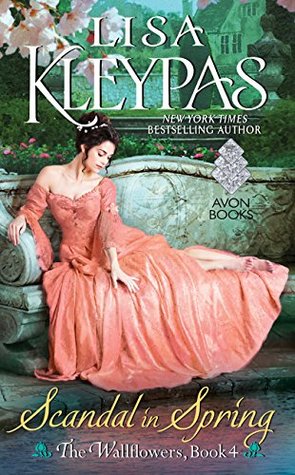
Scandal in Spring, the last book in the Wallflower series (sort of.) Being the last book in the series it suffers from that dread disease called Lastbookitus. There are no known cures.

The only one I know of is if the author would slow down and not be in a hurry to start their next book, or in this case turn to the dark side and write a contemporary romance. It may also suffer in comparison because it follows Devil in Winter. In this case the hero, Matthew, isn't as strong of a character as Daisy. And, I have come to believe that the heroes have to be as strong, if not stronger, than the heroines for the book to work and for the couple to balance each other out.
Poor Daisy. Daisy was such a wonderful secondary character in the previous Wallflower books. She was whimsical, funny and charming, but she loses what made her great in this story. Maybe some of the reason she seems weak to me in this story is that there may be too many of the other Wallflowers hanging around the pages. Yes, yes, I know that everyone wants to see what their favorite Wallflower is doing before the series ends - but hey, that's what short stories are for. Because we have so much wallflower catching up to do in this story, the romance between Matthew and Daisy suffers - this story has a rushed feel to it.
Matthew has a secret. Yes, our hero has a secret. First of all Matthew has been in luv with Daisy forever; he is almost a member of the family. He's at their dinner table a lot. The Bowman's horrible father has favored Matthew over his own children, so it's only fitting that the Bowman siblings should resent Matthew. He has been taken under Mr. Bowman's wing, eaten at their table and he seems to be exactly like Mr. Bowman - a cold, domineering man. But it's all a facade. As I said before Matthew's got a secret, actually he's got more than one secret. He has always loved Daisy, but has hidden that behind a cold facade. Because of the Kleypas male hormone thing that's been quite a struggle for him. But there is another secret! A horrible secret! He's not worthy! He's not worthy! It's so bad that when the reveal happens, you have to backtrack and read it over again because you miss it. You will find yourself scratching your head and asking, "This was the horrible secret?" I know I did. One paragraph - the secret is revealed, second paragraph - the Wallflowers help, third paragraph - the secret is solved. Another plotline which was supposed to add conflict but was handled so quickly that there wasn't any. So, why was it there?
Bottom line, this was almost the weakest book in the series. I was extremely disappointed that a great secondary character like Daisy didn't get her fantastic book. And, I wish Matthew had been just a little stronger. I also still want to know just what makes the entire Bowman family tick.
Time/Place: 1840s England
Sensuality: Hot
April 7, 2017
The Wallflower saga continues.
http://www.lisakleypas.com/
For a look on my thoughts concerning Devil in Winter see my old review. My mind has not been changed since then - still one of the best. You also get to read my review of another of Kleypas' better books Then Came You.
April 7, 2017
Nothing better than a stuffed-shirt.
http://www.lisakleypas.com/
Now we come to the second official entry in the Wallflower series and one of my favorites: It Happened One Autumn. One of the reasons this book is a favorite is because our heroine,
Lillian, and our hero, Marcus, rub each other the wrong way right away. What a fun couple. He is this uptight, priggish, snobbish lord and she is a free-spirited, acerbic, doesn't-give-a-hoot woman. As I've said before, there's nothing I enjoy more than seeing an uptight prig take a fall. Let me tell you, Marcus really puts up quite a struggle in this story and it's all very delicious. Was this a perfect book? No. Did I have some issues with it? Yes. But even though there were some hiccups in the road for me, this was my second favorite book in this series which says a lot considering that the Devil in Winter is in a class of its own.
So, we have an interesting hero in Marcus. First of all, he doesn't tower over people. He's shorter than most of the heroes who inhabit Romanceland. But, he is written with such a strong personality he's a match for all other heroes. Anyway, Marcus is a coooool guy. He's a look-at-me, I'm smooth, I don't get rattled, nothing upsets me - until Lillian barges into his well-ordered life.
I liked Lillian a lot. Was she a little bit over the top? Yes, but she had to be to counterbalance Mr. Level-headed Marcus. She was a whirlwind. She is loaded with schemes, dreams, and brilliant ideas, and she charges into things without really thinking. Even though she is this loose cannon, she doesn't see herself as such. She even thinks she would be a good partner in her father’s business, but she really hasn't got any business savvy. She's a too up-front, in your face kind of woman to fit into the covert world of business. She also doesn't suffer fools. She doesn't think too highly of the aristocratic world her mother wants her to be part of. In fact, she deliberately tries to irritate Marcus.
But, don't feel too bad for poor old Marcus. He doesn't care for Lillian. He considers her to be nothing more than a gold-digger - except, of course, she's got the gold but she's digging for a title. I guess she's a guy-digger. Or at least her mother is. Which leads me to another thought. Lillian's parents. Her mother is a social climber and her father is a wily, strong-willed business man who doesn't seem to care for his children. The Bowman parents put in an appearance as secondary characters and every time they showed up I found myself wondering more and more what made them into the couple they were. There are things that are hinted at but nothing is ever fully explained. I wish Ms. Kleypas had written a short story on this couple, not as they were when they were young, but what they were in these books. And, why they got to the point they were at. Interesting married couple who could barely stomach each other, but we never know why. Nor are we ever given a gentler glimpse of them.
The other secondary characters. The rest of the wallflowers put in a strong appearance in this book, Daisy especially, which is another oddity. Why is that an oddity? Well, since I've already read these books I know that Evie is the heroine who has the really strong book later on in the series. If ever there was an example of a strong secondary character not getting the book they deserve it is Daisy - but that will come later. In this book the Wallflowers once again demonstrate how wonderful a true friendship-bonding between women can truly be.
I've also arrived at the conclusion that no matter how strong the heroine is in any book, it is the hero who I zero in on. He can make or break a romance story for me. I can only think of a few romance stories where the two leads are on equal footing (Jessica Trent and Sebastian spring to mind). In this story even though Lillian's presence is felt throughout the entire book, Marcus is the one who overpowers it. He is the stronger of the two. Now, having said that I also believe that this pair really works as a couple. They balance each other out - he needs her irrelevance and she needs his grounding and together they make for a great couple.
If there was one weak part in this book it was toward the end when Lillian is kidnapped. Because the guy who does the kidnapping is our next hero, he can't be portrayed as being alllll that bad. So, I'm not sure why this scene was added. As I've been reading a lot of Ms. Kleypas books, one right after another, I've notice that in most of her books she adds things which in the end don't add anything to the book. They appear, they get solved, they disappear. All they do is take up space.
Overall, I liked this book. I thought it added immensely to the series and introduced a wonderful hero in the form of Marcus - too bad there is a Vincent. Highly recommend this story.
Time/Place: 1843 England
Sensuality: Hot